The Sales Room · 14 min read
He Said, “Send Me Something,” So I Put It in the Forecast
Nobody agreed to buy anything. We moved his politeness into a spreadsheet and discussed it at the Monday meeting.
September 6, 2026
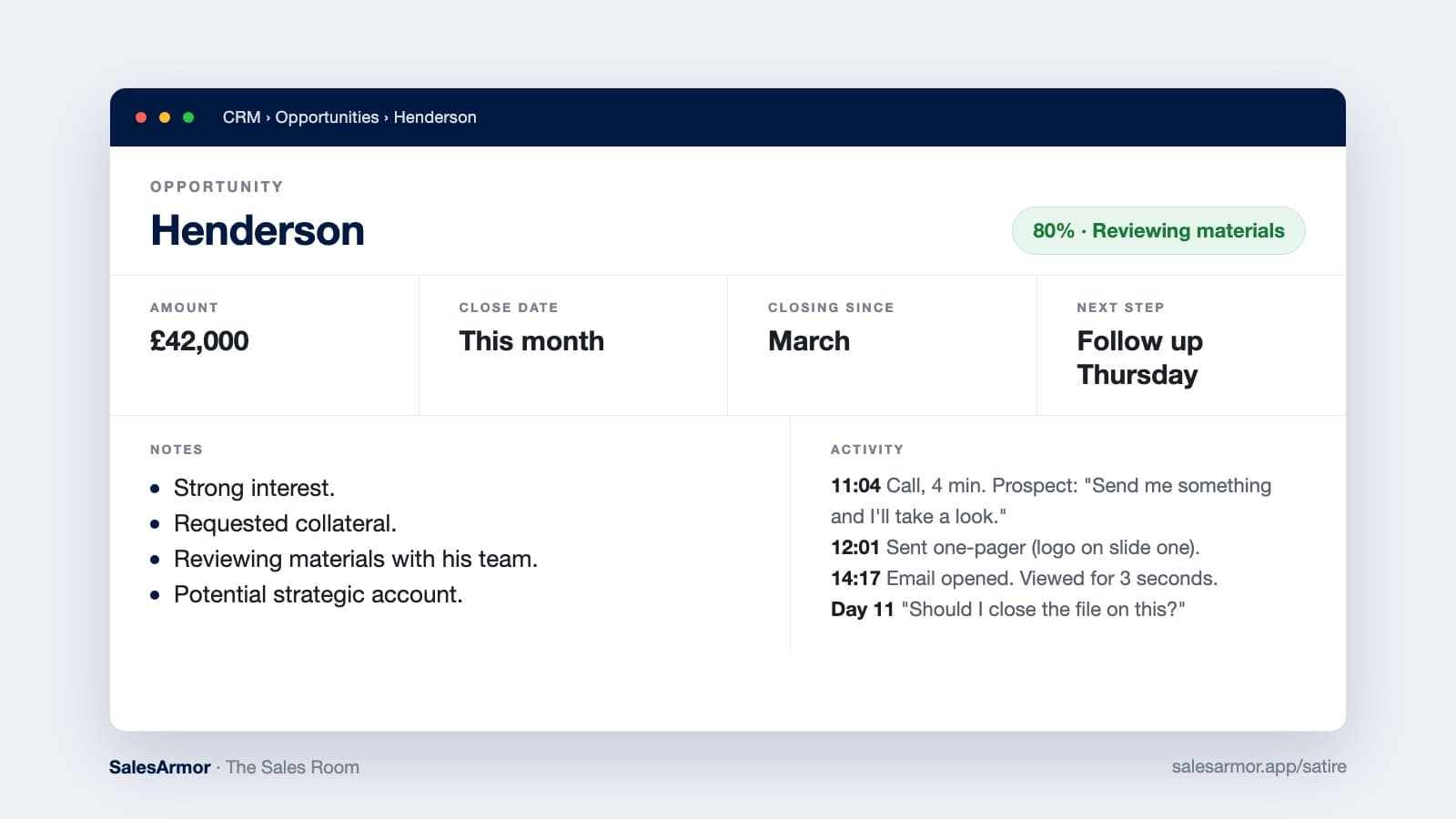
Nobody has ever taken a look.
I want to get that straight before we go any further. In the entire recorded history of human beings exchanging goods and services, going all the way back to the first guy who traded a rock for a different rock, not one person has ever taken a look. It has never happened. It's not something people do. It's a noise they make with their face so you'll stop talking.
"Send me something and I'll take a look."
That's the whole sentence. That's the most common sentence in business. More common than "let's circle back," more common than "per my last email," more common than "any updates on your end." It's the noise the economy makes when it doesn't want to hurt your feelings.
And the beautiful thing, the genuinely beautiful thing, is the tense. I'll take a look. Future. Not now. Later. There's another version of this man coming, a better version with more time and a clearer head, and that man is going to sit down at some point and look at your thing. He's coming. He's just not here right now.
He's never coming. That guy doesn't exist. That guy has never existed. But he's the most valuable employee in America because he's carrying about forty percent of the pipeline on his back.
The voice changes first
Here's how it happens, and if you've ever sold anything, you know the exact moment I'm talking about.
You're on the call and it's going okay. Not great, okay. Then the other person's voice changes. It gets warmer. That's the tell, warmth. You think you're winning. You're not winning. Warmth on a sales call is the sound of a door being closed very softly by a man who doesn't want to wake the baby.
Then out it comes. "You know what, this actually sounds interesting. Why don't you send me something and I'll take a look."
And you go, absolutely! Absolutely I will. Thank you so much for your time.
You thanked him. You said thank you. He just handed you eleven days of slow-motion humiliation, and you said thank you so much for your time. Then you hung up and typed the word "Interested" into a computer.
I did that for years. I'd hang up and put a little note in the CRM. Interested. Requested materials. I typed that with my own hands, like a moron. Because in my head, he's a serious guy. He's got a lot going on. He can't just decide on a phone call. He needs to review the materials with his team.
Review the materials. Like there's a room. Like somewhere there's a long table, my one-pager goes up on a projector, and a man stands up and says, gentlemen, we have a decision to make about the invoicing software.
There's no room. There's no table. There's a guy in a Toyota Camry in a parking lot who wanted to eat a sandwich. You called him, and he said send me something so he could get back to the sandwich. That's it. That's the entire mechanism.
The industry knows and nobody says it out loud
This isn't a secret. A VC named Bradford Cross put it plainly on Twitter years ago: when someone says "send me a deck," it means "not interested." He said don't send decks before you pitch, because if they didn't want to hear the pitch, the deck isn't going to save you. We know that, but the minute it happens, we think, okay, the idea failed as a conversation, but maybe it'll thrive as an attachment. Now you're formatting your own rejection. Put page numbers on it. Make it official.
There's a whole blog post on a sponsorship site titled "Just Send Me a Proposal: The Five Words You Never Want to Hear." That's how strange selling is. The terrifying sentence arrives in a warm voice, thanks you for your time, and gives you two hours of homework.
And yet, go on YouTube right now and search "send me an email objection." You'll find nine hundred videos of men in quarter zip pullovers standing in front of whiteboards. Three easy steps. The five step framework. The proven script.
There's guys doing live roleplay with each other on camera. One plays the prospect and does a little voice, and the other goes, okay now watch what I do here. Then he does the thing, and the fake prospect goes, "wow okay, Thursday at two works for me," and they both nod.
They simulated a sale. That's a thing you can do now. You can simulate a sale. It's called content.
The smartest and most annoying answer comes from sales trainer Michael Pedone. He says the key isn't having a good response, it's eliminating the objection before it happens. He's completely right, which is what makes you want to throw something. You're standing in the smoke asking what to do, and a calm man says, "The key is not having a fire." Fantastic. Now the fire feels stupid.
Which is true. It's completely true. It's also like telling a guy who just got dumped that the solution was to be more interesting eight months ago. Thank you. Very useful. Where were you in March.
The stuff people actually say to fight it
You're afraid to ask, "Is that a no?" because the bastard might answer you. So Sandler gives you a move called the negative reverse, where you say, "I'm not suggesting this is you, but usually when people say that, they're not really interested." Now the buyer has to defend himself against the accusation that he doesn't want the meeting he doesn't want. That's sales training's answer to fear. Make the stranger reassure you that you're still pretty.
Say that out loud. Say it to a stranger who has done nothing to you. "I'm not suggesting this is you, but." That's the sentence version of a guy saying "no offense" and then telling you your kid is ugly. It's a little trap. You've called him a liar with a smile on your face. The insane part is, sometimes it works. He gets embarrassed and says no no, I really am interested, and now he has to prove it. So he takes the meeting.
Somebody got a commission that quarter off shaming a stranger into feeling rude.
Then there's the tough guy version, which I love because it's genuinely unhinged: "I'm happy to bring you information. It all comes attached to me. See you Thursday at two."
It all comes attached to me. Like you're a haunted lamp. Like the information can't be removed from your body by any known medical procedure. I've never had the guts to say it. You have to deliver it with total confidence or it sounds like a ransom note, and I've never in my life had total confidence about anything, including my own name.
Then there's the psychopath, and the psychopath wins. The psychopath calls, the guy says send me an email, and the psychopath says: "I did. You didn't answer. That's why I'm calling."
I hate that that works. It works.
Then Monday rolls around and everybody's scared, so somebody opens the slide deck because if fear has bullet points it counts as management. First it's, “Eighty percent of sales take five follow ups.” That came from a 1942 survey of fewer than forty door-to-door salesmen on Long Island, and the rep knows that's insane, but the rep also has a target and the room has gone quiet, so fewer than forty men on Long Island in 1942 get to decide what happens to Tuesday. Then it's, “forty four percent of reps quit after one.” That one has no source at all, it just walked into the meeting wearing a percent sign, and nobody asks for ID because everybody's already frightened. That's how an imaginary number gets a real person to send another email. And then there's the one that's actually real: eight out of ten buyers say they'd prefer to be contacted by email.
Sit with that last one. Eight out of ten buyers prefer email. Of course they do. Email is where things go to not happen. You asked people how they'd like to be approached, and they said, ideally, in a format I can ignore forever with zero social consequence. Somebody wrote that down as a preference. Put it in a slide. The data shows buyers prefer email, so let's do more email.
No. The data shows buyers prefer to be left alone, and email is the closest legal alternative.
Now the part where I'm the bad guy
I do it too.
I do it all the time. Somebody calls me about a thing, and I have no intention, zero. I would rather chew glass. Then I hear my own voice go up half an octave into that horrible warm register, and out it comes. "You know what, send me something and I'll take a look."
And here's the sick part. I feel great. I feel wonderful. I've solved my problem, I've given a stranger a gift, and it cost me nothing. I'm a philanthropist. I'm handing out hope like candy on Halloween, and it's free because it isn't my hope. It's his. I'm just giving him back his own hope with a little interest on it.
Then the email comes, and I don't open it. Then the second one comes, "just floating this back to the top of your inbox," and I don't open that either. Then the third one, the sad one, "I know things get busy, should I close the file on this?" I feel a hot little flash of shame that lasts maybe a second and a half. Then I delete all three at once, because deleting three at once is easier than deleting one. Then I go get a coffee.
I've probably done this two hundred times. That means two hundred people went home thinking they had a decent call because I couldn't spend four seconds saying "no thank you." Four seconds was the entire bill, and I refused to pay it. So I broke the disappointment into little payments over several weeks and put them in somebody else's name. Then I got coffee like I'd finished something.
That's not politeness. Let's stop calling it politeness. Politeness is when the cost lands on you. This is the opposite. This is outsourcing your own awkwardness to a stranger who works on commission. It's incredibly efficient. Everybody walks away feeling good, and only one person's life gets worse, and he doesn't find out for eleven days.
And then he has to go make the something
Because that's the other half of it. You said send me something, so now he has to make the something. He spends two hours customizing it, putting your logo on slide one and swapping in the case study from your exact industry. He isn't an idiot. He knows what this could be. But hope has a manager, and the manager wants the deck. So you didn't reject him. You commissioned your own rejection.
He rewrites the subject line six times. He reads it out loud in his car. He sends it to a coworker and says "is this too long," and the coworker says "it's fine" without opening it. Then he sends it anyway.
And then it lands in your inbox next to an email about parking, an email about the dental plan, and eleven newsletters. You leave it there because deleting it would require the exact decision you used the email to avoid. You know you're never opening it. You just want it to remain technically possible until it dies of natural causes.
Then he follows up. Then he follows up on the follow up. He starts getting weird. He puts "quick question" in the subject line because somebody on LinkedIn said "quick question" gets opened more, and did not say by whom, so now he's a man who lies in subject lines. That's who he is now. He doesn't have a quick question. He has a mortgage.
Why he won't just take the no
Obvious question. Why doesn't he just say, cool, so is that a no?
Because a maybe pays the rent for one more week. That's why.
A no means he has to go into the CRM and change the stage to Closed Lost. A maybe means the number stays where it is. That number goes into a forecast, the forecast goes into a meeting, and in the meeting his manager says "where are we on Henderson." He gets to say "Henderson's reviewing materials," everybody nods, and he keeps his job for another seven days on the strength of a man in a Camry who wanted to eat a sandwich.
Chris Voss, the FBI hostage negotiator, calls this a counterfeit yes, and sales takes that fake yes and puts it in a spreadsheet at ninety percent confidence. Nobody heard a yes, but the spreadsheet is ninety percent sure it did. At this point, the most confident person in the deal is a cell.
So the maybe goes into the forecast, the forecast goes into the quarter, and the quarter goes into the board meeting. Now a room full of adults is discussing the intentions of a man in a Camry who wanted to eat a sandwich. Nobody found out what he meant. They just kept passing it upstairs until lunch had a revenue target.
The fix, which nobody will do, including me
The fix is embarrassingly simple.
Say no.
That's it. When you don't want it, say "no thanks, I'm not going to buy this, please don't follow up." Six seconds. It feels terrible for six seconds. It feels like slapping a nice person who has done nothing to you. Then it's over. He calls somebody who might actually want the thing, you've handed him back forty hours of his life across a year, and neither of you has to attend the eleven day PDF funeral.
There's one piece of advice in this entire industry worth keeping, and it's that the second best thing you can hear is no. Yes buys the thing, no gives you your life back, and maybe makes you rewrite a subject line six times and perform it alone in your car. Maybe is a part-time job neither person remembers applying for.
And if you're the one selling, when he says send me something, just ask, "do you actually want to read this, or are you being polite?" That's it. It's horrifying because he may tell you the truth while you're still on the phone, and then you have to have an emotion during business hours. The approved alternative is having the same emotion slowly for six weeks.
Say it. Watch what happens. About one in five will laugh and tell you the truth. That one is worth more than the other four put together, and the four will be so relieved that they'll remember you in a year when they actually need the thing.
Nobody does it. I don't do it. You won't either. Because it turns out human beings will do almost anything to avoid four seconds of awkwardness, up to and including maintaining a fake relationship with a stranger for six weeks.
Anyway
So that's where I've landed on it. "Send me something and I'll take a look" isn't rejection, because rejection ends. This is a no with errands. I save myself four awkward seconds, a stranger gets two hours of work and eleven days of wondering, and I still leave the call thinking I'm the nice one. That's an unbelievable tip to leave somebody.
And technically, everybody kept their word. The buyer said he'd look, the seller said he'd follow up, and the company gets to keep calling it a deal. That's useful because removing it means somebody has to walk into the pipeline review and admit that two adults were polite to each other and nothing got sold. So they schedule another meeting. Maybe the calendar can buy it.
We built all of that. Billions of dollars of infrastructure. To avoid one sentence. Anyway. This was great. Really good talk. Send me something and I'll take a look.
Rehearse it before the real call.
SalesArmor is an AI buyer you talk to out loud, built from a real prospect's LinkedIn profile. Ask it whether it actually wants the deck, and find out what you do when it says no. The first five calls are free.
Try a call →Keep reading