The Sales Room · 12 min read
He Opened It Twice!
Dave is aware of me. I exist in the mind of Dave.
September 6, 2026
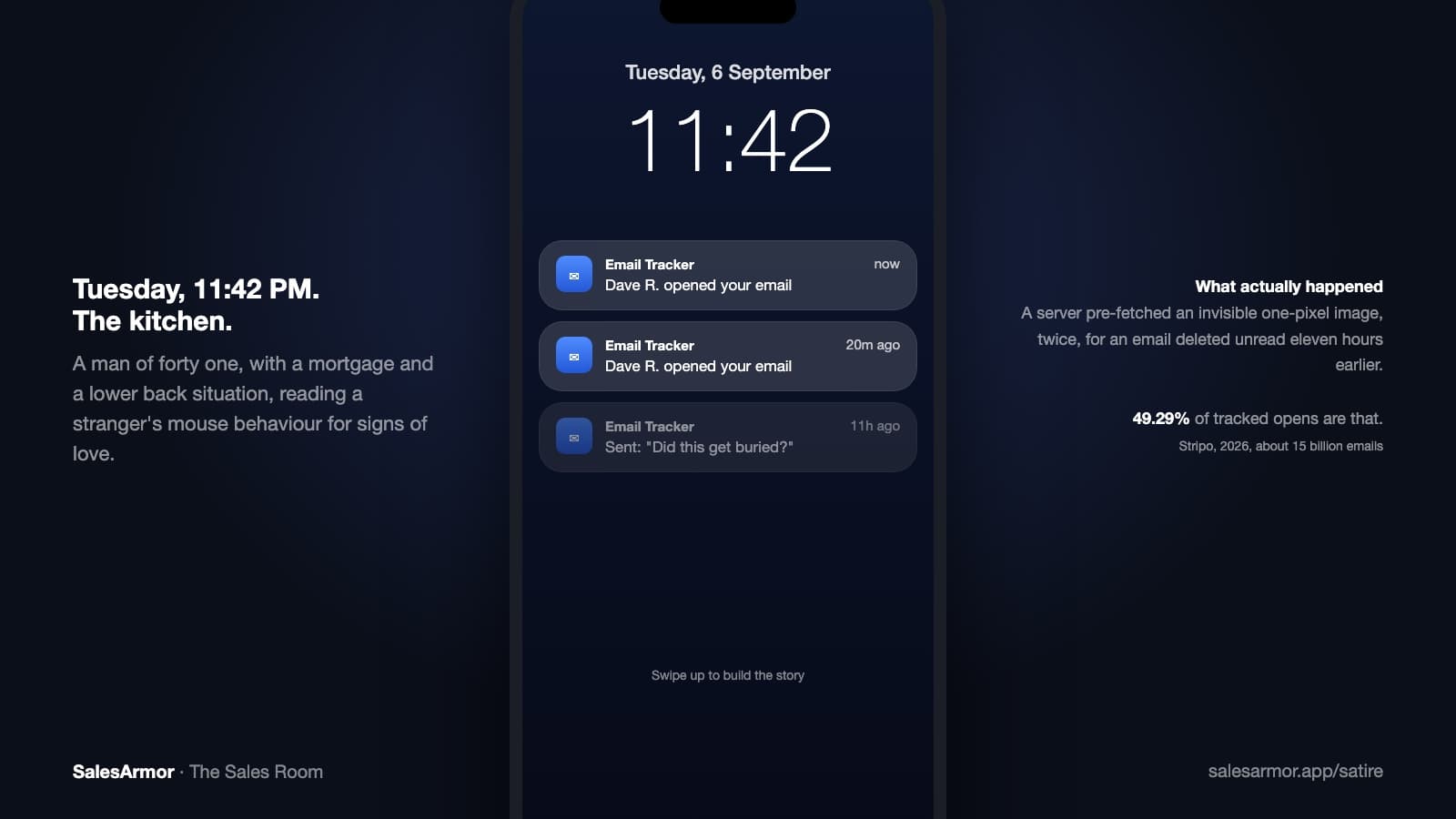
There's this little gray box that comes up in the bottom right corner of your screen. It's gray, it's polite, and it's gone after four seconds.
"Dave R. opened your email."
That's all it says, and my body reacts like we got him. We didn't get him. Nobody replied. Nobody bought anything. A rectangle mentioned Dave, and somehow that's the best thing that's happened to me all Tuesday. I open the refrigerator with more intent than Dave has shown here, and nobody at the yogurt company calls that a lead.
Then twenty minutes later, the box comes back.
"Dave R. opened your email."
Twice. Oh, now we're serious. One open could be anything, but two opens and I'm planning our fiscal year together. I know nothing about Dave except a first name and a last initial, and somehow we're already in a committed business relationship. He just needs space.
And I want to be very clear about where I am at this point in the story. It's a Tuesday. I'm forty one years old. I have a family, a mortgage, and a lower back situation. And I'm standing in my kitchen holding a phone, analyzing the mouse behavior of a man I've never met, looking for signs of love.
The tea leaves
Because once you have the data, you can't not read it. That's the trap. The number appears, and now you're responsible for having a theory about it.
It's not enough that he opened it. Now I know when. 11:42 at night. What's a man doing at 11:42 at night? He's in bed. His wife is asleep. And he's looking at my proposal in the dark.
That's not a business interaction. That's an affair.
Then the tool tells you how long he spent on it, which page he was on, and whether he forwarded it. Forwarded. Holy shit, now there are witnesses. One click and I've promoted myself from unanswered email to internal initiative. I don't know whether it went to finance or somebody Dave trusts to ask how to make me stop. The dashboard gives me one word, then leaves me alone with my mortgage and full creative control.
So of course I build the story, because what else can I do with one word and a mortgage? Everybody in sales does this. He forwarded it to finance. Finance is reviewing it. That's why he's quiet. In regular life, silence means nobody's talking. In a pipeline review, silence has been promoted to internal movement. We put a visitor badge on nothing and called it finance.
Nothing is moving internally. There's no internally. But I've got three data points and a mortgage, and out of that I will construct an entire relationship, complete with a supporting cast, in about ninety seconds.
We used to call this being delusional about a person who isn't texting you back. Now there's a dashboard for it, so we call it intent data.
The six emails
And while all this is going on, you're also writing to him, because that's the job. There are six emails because training has convinced everybody that when a locked bathroom door doesn't answer, the professional thing is to knock six different ways and take notes on your technique.
Email one. "Great speaking earlier, attached is the overview we discussed."
That's a completely normal email. He promised an overview, he attached the overview, and he assumes the other grown man will answer him like people do in every conversation that isn't being inspected by a pipeline. He has no idea that three emails from now he'll be assuring another grown man that the touching is gentle.
Email two. "Just circling back on this." Fine. Normal. Circling. Like a hawk. Like a man with a strategy. Nothing desperate is happening. I'm simply flying above your home in smaller and smaller loops.
Email three. "Bumping this to the top of your inbox." Slightly odd, physically. I've reached into his private space and moved something. But okay. Apparently I'm in there now, rearranging the furniture.
Email four. "Just a gentle nudge on the below." Gentle. He said gentle. He's telling you how hard he's touching you. That's a man who's become aware of his own hands.
Email five. "I know things get busy, wanted to make sure this didn't slip through the cracks." Now he's making excuses on your behalf. He's building your alibi for you. You didn't ignore him. No, of course not. Things get busy. There are cracks. Things slip into them. It happens.
Email six. "Did this get buried?"
Did this get buried. He's asking about the funeral now. He knows. On some level, he knows exactly what happened, and he's asking you to confirm it in writing.
Six emails. Zero new information. Because that's the actual problem with the entire discipline, and nobody says it out loud. There are only so many ways to describe an unanswered email as a fresh development.
Nothing happened. That's the update. Nothing continues to happen, and here is my fourth message about it.
Journalism has a bar for this. Something must have occurred. You can't run a piece that says the mayor still has not called me. Sales has no such bar. In sales, the absence is the content. You're paid, actual money, to generate correspondence out of a void.
An entire industry devoted to one sentence
And because the whole thing is so obviously humiliating, we've built a linguistics department around it. Go search "alternatives to just checking in." There are twenty alternatives, then twenty two, then thirty better alternatives, then sixteen stronger alternatives that win responses and sales. Every sales software company on earth has published one of these and updates it every year. That's how business fixes humiliation. It doesn't stop the begging. It gives the begging synonyms.
Think about the scale of that. Thousands of hours of human thought. Professional writers, editors, SEO people, all of them working on the problem of how to say four words without saying them.
Please answer me.
That's it. That's the sentence. Every single one of those thirty alternatives is that sentence wearing a different hat. "I came across an article I thought you'd find interesting." No you didn't. "Wanted to share a quick resource." No you didn't. You want him to answer you.
And he knows. Of course he knows. Nobody gets an article about supply chain trends and thinks, what a thoughtful man. He knows I want an answer, and I know he knows. But I can't say please answer me because then I'm desperate, while sending him an article is somehow professional. So because I'm afraid to ask one question, I assign him reading. It's begging, except now the other person has homework.
And now the part that ruined my life
So a while ago I found out how the little gray box actually works. There's an invisible picture in the email that's one pixel, so you can't see it. When the email loads that picture, the recipient's computer fetches it from a server. The server sees the request and reports an open. That's the whole technology. It doesn't know Dave read the proposal. It knows a computer asked for the world's smallest picture.
And because I need this deal, I let that speck explain Dave to me. It's a doorbell that can't tell a buyer from a machine, and I'm already fixing my hair.
Except a few years ago Apple decided that was creepy, which it is, so they made the mail app grab all the pictures ahead of time, in the background, on delivery, before anybody looked at anything. Now the pixel fires whether the message was read, ignored, or deleted without ever being seen. The dashboard can tell me somebody opened an email that nobody opened. Two machines exchange the world's smallest picture, and a human gets a follow-up task.
There was a study this year that looked at fifteen billion emails and found that just under half of all tracked opens are machines pre-loading a picture, not people. Just under half. And we didn't throw the dashboard away, because once bad information has a login and a little colored chart, people stop calling it bad information and start asking a salesperson what he's going to do about it.
So let's go back to Dave. Dave opened it twice, at 11:42 at night. That's what the dashboard says. What it actually knows is that a computer asked for a picture twice. That's it. Nothing about Dave. But "nothing happened" isn't a next step, so now a grown professional has to stare at two machines exchanging a picture and explain when the deal is closing.
Or.
A computer in a building in Nevada, that has never met me and never will, requested an invisible picture, twice, for an email that was deleted unread eleven hours ago. Then a different computer told me about it. Then I felt something in my chest.
That's what happened. That's probably what happened. I got emotionally moved by a data center doing routine maintenance.
I want to say that again, but plainly, because it wasn't beautiful. A computer did routine maintenance, another computer tattled, and I took it as encouragement. I'm forty one years old, standing in a kitchen, getting led on by electricity.
Okay, and I'm also Dave
Because here's the other half, and this is the part I like least.
I'm Dave. Obviously I'm Dave. Everyone reading this is Dave.
Somewhere right now there's a guy watching me not open his email and building a story about it. And what I'm doing, in reality, is nothing. There's no story. I'm not weighing it. I'm not socializing it internally. I saw the name, registered that it wasn't urgent, and moved on with the exact emotional weight of walking past a bench.
And now, because of Apple, I don't even have to open it to open it. My phone opens it for me, immediately and every time, so a stranger gets to have a feeling about me while I continue not knowing who he is. I've found a way to ignore a man with perfect attendance. My phone is the best prospect in the account, flawless engagement and absolutely no intention of buying anything.
So at 11:42 my phone opens the email, his software tells him I opened it, and while I'm somewhere else doing nothing, he's in the kitchen trying to figure out what my phone meant. His job requires an opinion before reality has provided one. My phone meant nothing, because it's a phone. But he's the one with a mortgage, so now he has to explain why it hasn't bought yet.
The breakup
Which brings us to the last email in the sequence, the breakup email. This is where business looks you in the eye and pretends there's a file.
"I'm writing to follow up on my email and voicemail. We're closing files for the month. Typically when I haven't heard back from someone it means they're either really busy or they aren't interested. If you aren't interested, do I have your permission to close your file?"
It asks the person ignoring you for permission to stop being ignored. That's like asking a locked door to approve you leaving the porch.
Permission to close your file.
That's a man breaking up with somebody who's never met him. That's a guy standing in the rain outside a house where nobody knows his name, saying, I think we should see other people.
And it is, by a mile, the highest performing email in the entire sequence. The template libraries claim absurd numbers on it. Seventy six percent response rate, one of them says. Seventy six.
Six emails of value, insight, case studies, and articles I thought you'd find interesting. Nothing. Then he says "should I close your file" and the guy writes back in forty minutes. Oh, now his fingers work. The product couldn't move him. The case studies couldn't move him. But suggest that a stranger might think he's an asshole and suddenly we've got engagement. His pain point was manners.
Guilt is the highest converting emotion in business. Everybody in the industry knows this, and nobody puts it in the deck. And the con inside the con is that "we're closing files for the month" isn't a real thing. There's no file. Nothing is closing. Nobody is going through a cabinet on the 30th.
It's a made up deadline attached to a made up consequence, and it works every time. The second that imaginary file starts closing, we're typing like the police found our fingerprints. We don't want the product. We just need whoever works near the imaginary cabinet to know we're good people.
Anyway
So that's the whole apparatus. The open might be a machine, the internal movement might be silence, and the file definitely doesn't exist. But then an actual person has to carry all of that into a pipeline review and discuss what happens next, because the software has no place to put we don't know anything. The system creates nothing, gives it to the rep, and asks why he hasn't closed it.
And somewhere in there, some money changes hands, and we call the whole thing a pipeline.
The tragedy isn't that it's cynical. It's that the only genuine emotion in the entire process belongs to the person who's wrong. The rep is the only one actually feeling something, and what he's feeling is a response to a server in Nevada.
I think about that guy, honestly, because he's not stupid and he's not naive. He's working with the evidence the system gave him, and the system gave him a cheerful little box.
Tomorrow it'll light up again.
"Dave R. opened your email."
And then again. He'll know exactly how unreliable that is, but knowing that doesn't make the pipeline review go away. So a moment later, finance will be back in the imaginary conference room.
Nobody works harder in sales than imaginary finance.
Rehearse it before the real call.
SalesArmor is an AI buyer you talk to out loud, built from a real prospect's LinkedIn profile. Ask it whether it actually wants the deck, and find out what you do when it says no. The first five calls are free.
Try a call →Keep reading